Last week, I headed up to Bloor between Royal York and Islington for the last days of protest against this current phase of bike lane removals. (Here’s my post on my previous visit.)
Oct. 20
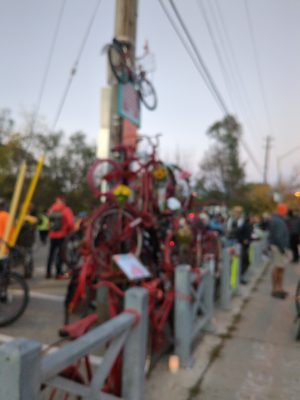
It is about a 9 km ride from Parkdale with several big hills, which is a lot for me. When I arrived, out of breath, at the usual meeting spot—a municipal parking lot by Tom Riley Park—there was a new monument of red bicycles (🎁), representing fallen cyclists, installed by the guerrilla art group Urban Repair Squad.
The vibe was chill and sociable. People milled around chatting, some making last-minute protest signs. Someone had brought samosas and naan. A small girl of about ten was at her family’s cargo bike, making cups of hot chocolate for people. A small contingent of cyclists was riding laps in the area. By the side of the road, people held up signs and rang bike bells in response to supportive honks.
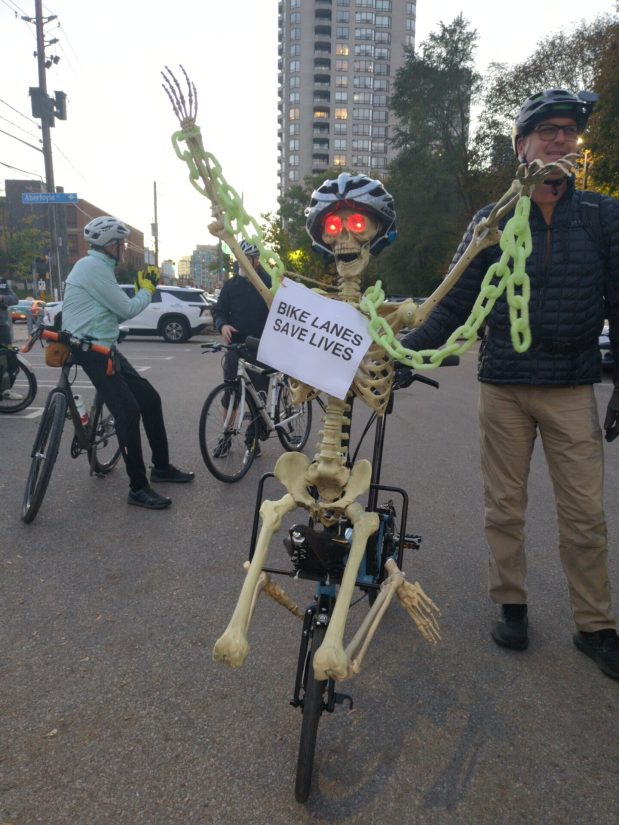
As before, the event attracted a few curious passersby, both supporters and naysayers. An older man was wandering from group to group, explaining how he was an avid cyclist (they always are), he just wasn’t in favour of these bike lanes, etc. I asked him, “Can I show you my photos of bugs?” and pulled out my phone.
“Are you from the neighbourhood? Because—”
“No, I’m from Parkdale, but I typically have to go a little ways to find the really good stuff. This is a sumo mite. They’re called that because in the spring, which is their mating season, they wrestle each other—”
I eagerly explained my latest arthropod photos until he hurriedly excused himself.
A few local news teams were on site as well, interviewing various people. A CP24 reporter was pleased to get the opportunity to talk to one protester in a motorized wheelchair, as, he explained, this was not a perspective often highlighted in the debate. (Another wheelchair user, Paralympic swimmer Aly Van Wyck-Smart, had recently been arrested at the protests.)
Near 8 p. m., the mood changed as organizers reported two trucks carrying heavy equipment had arrived near Islington station, and everyone headed over. There were what are called cold milling machines for removing layers of asphalt; dump trucks, for carting it away; water trucks for reducing dust; and various other machines for laying down new asphalt. (As another protester pointed out, is all that strictly necessary for removing lines of road paint?)
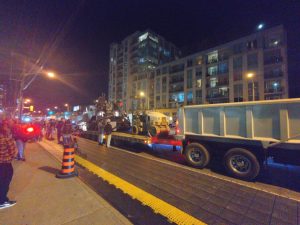
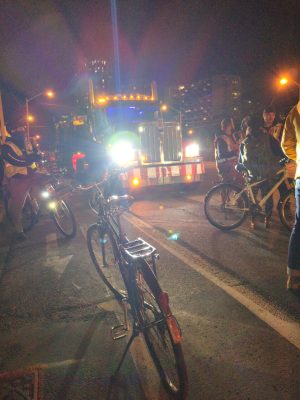
Crowds of cyclists gathered around the trucks to block them from unloading. Police began arriving in force, and a few organizers circulated making sure everyone had the legal support phone number written on them in Sharpie in case of arrest. At one point one of the trucks drove off, to cheers (but with some cyclists tailing it to see where it went). The bulk of the crowd assembled behind the second truck; I was with a smaller group in front, which turned out to be a good choice.
Though it was getting a bit late for a weeknight, there were still a few passersby out and about on the sidewalks. I hastily moved my bike out of the way of a woman (in her twenties or thirties, I think) carrying a tray of coffees, assuming she was just trying to get through, but it turned out she was offering them to us! She had moved to the area around when the bike lanes were first installed, and had been dismayed to hear of local businesses that were fervently against the bike lanes. To her, she said, it seemed like they were saying her safety didn’t matter.
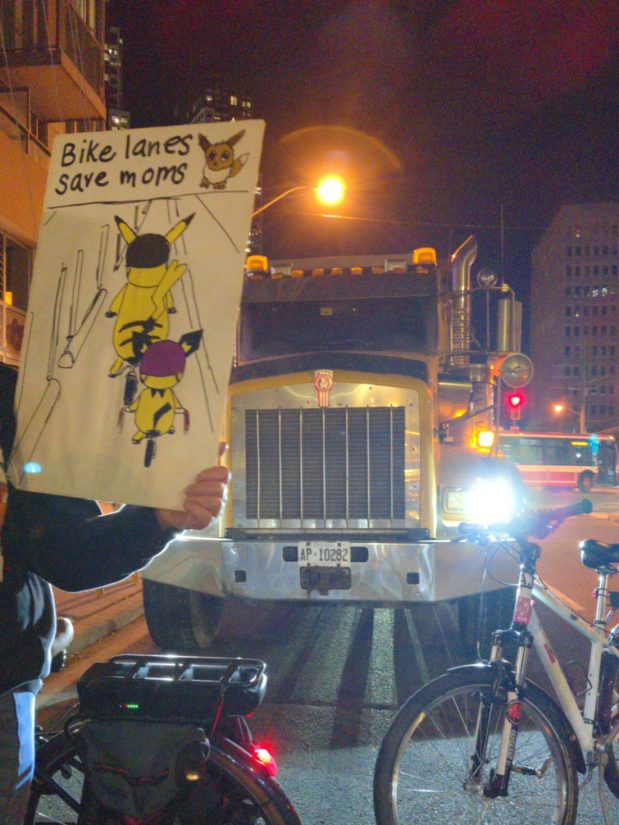
Around the corner on Islington, a dump truck and another tractor-trailer carrying machines had pulled up, and several of us went to block them in. I ended up standing in front of the dump truck chatting with a couple other people; we were all strangers to each other. Both of them had just come out to the protests for the first time. One had an adorable hand-drawn Pokémon sign that someone else had given her, saying “Bike lanes save moms” (“I’m a mom,” she explained).
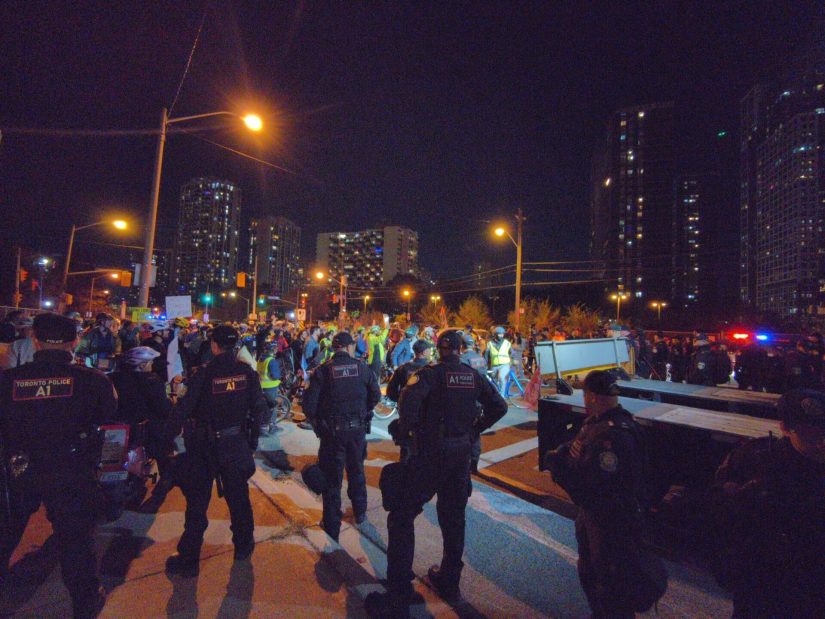
We could have used more people, but it turns out the cops had surrounded the crowd in front of the second truck and were not letting anyone past. Presently some cops came by and threatened to arrest us if we did not move (we reluctantly moved after more showed up). An organizer (who had been sort of mediating with the construction workers, in a matter-of-fact “you probably didn’t expect this, so here’s what’s going to happen” way) gave us a little pep talk, saying it meant a great deal to him, as someone who grew up here, to see so many people coming out, this was only the beginning, etc.
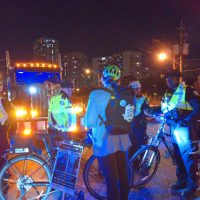
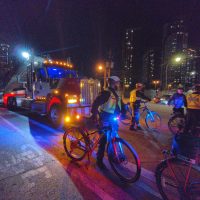
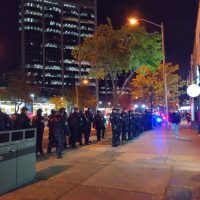
The workers began unloading the equipment. Up the street, we saw a cyclist fall; it turned out a cop had pushed her over. The milling machine had been started up and was proceeding eastward on the south side of Bloor, grinding away the pavement. A large cloud of dust and fumes was being kicked up. A crowd still surrounded the scene, but the police were clearing the way ahead of the machines, forcing people back onto the sidewalk. A Court Services truck stood ready in case of mass arrests (there were none).
I was hoping to 1) get home un-arrested and 2) in time to finish some work that day, so I headed home.
Oct. 21
I was super wiped after the previous day, but did a lot of eating and got my energy up in time. There were several other cyclists also on the way to the protest who I fell in with as we neared Bloor and Royal York Blvd. We arrived shortly after 7.
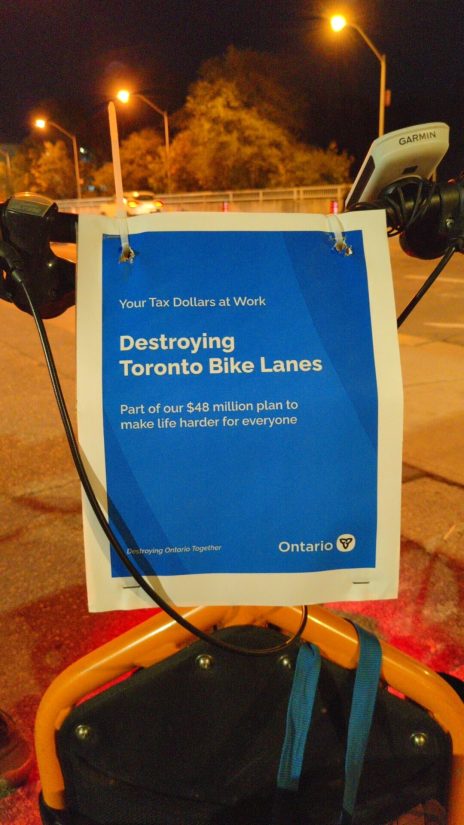
People were handing out signs and helping people affix them to their bikes. One person had printed out a stack of these mock announcements which they’d found on Reddit. There were oodles of police stationed around the neighbourhood, and someone even reported there was a mounted unit.
The organizers conferred with each other and then announced that, as legal support was not available until after 11, everyone was to be entirely peaceful and co-operative and not get arrested. The plan was to do a rolling “die-in” in the westbound lane (the north side of Bloor), which they still had yet to resurface, moving down the lane as police cleared the way. At around 8 p. m. we all rode out together eastward down Bloor, where the freshly-repaved lane was still cordoned off.
At Bloor and Royal York, where work was starting, the equipment was surrounded by rows of police, and more were lining the sidewalk, blocking off the lane that was to be repaved. Many of us ended up outside the Second Cup on the corner, where there was a bit of open space (I took the opportunity to pop in for a hot chocolate).
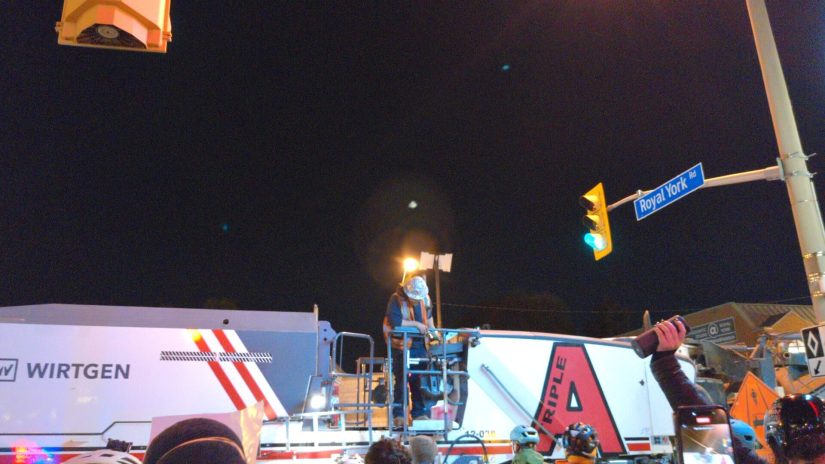
People put on respirators and N95/KN95 masks to guard against the dust and noxious fumes. (We seemed better protected than the police, who for the most part did not have any.) There was a funny moment when the milling machine began slowly backing up in preparation, and someone in the crowd started playing apropos Star Wars music from a Bluetooth speaker. We began slowly filing down the sidewalk to join the die-in; there was so little space we had to go in single file, and on this slightly busier stretch of Bloor it was still early enough in the evening that there were still people going to the restaurants, shops, movie theatre, etc. On Montgomery Rd., a film crew was set up in front of a church, bright lights lighting up the front of the building.
I was among the last to the die-in, which stretched almost to Mimico Creek. I lay down with other cyclists in the lane in front of a rather desolate parking lot just on the other side of Montgomery, next to a Tridel sales centre for the upcoming development on the site. My bike bell was within reach, so I could join in ringing my bell whenever a supportive driver honked.
Presently, around 9 p. m., organizers coming down the street announced that we had “made our point” in showing them “what’s going to happen—bodies in the road”. It seemed a little premature (I was more than willing to stay at least a few hours more), but it wasn’t my call to make, so a friend and I headed the short distance westward to the Tom Riley Park Green P.
To my delight, the family with the hot chocolate cargo bike was waiting for us. (The little girl politely but firmly instructed us to make an orderly line.) We stood around chatting over cups of hot chocolate (there were even marshmallows). Afterwards, my friend went west to Islington station and I headed east, with pool noodle out for safety and a big “Sorry! I wish I was in a bike lane” sign on the back of my bike. I was completely exhausted on the ride back, but managed to make it up all the big hills without getting off and walking (my criterion for success).
So what now? Well, the province has issued an RFP for bids on removing the rest of the Bloor, Yonge, University Ave., and Avenue Rd. bike lanes. As John Lorinc writes, much of the infrastructure is not just concrete curbs and flexi-posts like on the westernmost stretches of Bloor; there are poured concrete medians and street elevations that will take a lot of work to remove. And like many protesters observed, the downtown lanes are much more intensively used and easier to access; many, many more people will be able to come out to protest. Protesters have already made the first bike lane removals slower, more expensive, and more disruptive to traffic than promised. For the Ford government, it will only get more difficult from here.